The Geometry of Nature: Understanding 3D Floral Strawberry 9 Layer Mandala Art
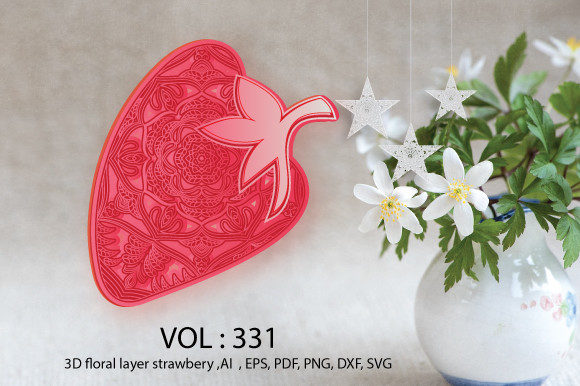
At the intersection of botanical illustration, sacred geometry, and digital sculpture lies a distinctive creative form: 3D Floral Strawberry 9 Layer Mandala Art. This medium combines the organic curves of strawberry plants with the structural precision of mandala design, executed across nine distinct depth layers to produce a stereoscopic, immersive visual experience. Unlike flat mandalas or standalone fruit renderings, this layered approach introduces a spatial dimension that transforms how viewers engage with both natural and geometric motifs.
What Defines the Nine-Layer Structure
The number nine in this art form is not arbitrary. Each layer serves a specific optical and compositional function. Layer one typically anchors the composition with a central strawberry or floral stamen, while layers two through four build outward with repeating petals, seeds, or calyx details. Layers five to seven introduce intermediate geometric rings—often lotus petals, concentric circles, or star polygons—that bridge the organic center with the outer decorative border. Layers eight and nine function as the outermost mandala ring and a subtle depth frame that enhances the three-dimensional effect when viewed stereoscopically or with parallax rendering.
In practice, artists working with 3D Floral Strawberry 9 Layer Mandala Art must consider how each layer interacts with adjacent levels. A strawberry motif placed on layer three, for instance, might cast a shadow onto layer four if rendered with volumetric lighting, or it might overlap with floral elements on layer five to create a sense of depth. This stacking logic mirrors how natural strawberry plants grow in successive tiers—leaves above fruit, fruit above stems, stems above runners—making the nine-layer structure a thoughtful nod to botanical stratification rather than a purely decorative choice.
Visual Characteristics and Design Language
The aesthetic of this art form is immediately recognizable by its contrast between soft natural forms and rigid geometric frameworks. Strawberry shapes are typically stylized but retain their iconic heart-like silhouette and seed patterning. Floral elements often draw from rose, lotus, or daisy families, their petals repeated radially to match the mandala's symmetry. The color palette leans toward deep reds, blush pinks, forest greens, and gold accents, though monochromatic and inverted-color variants are common among digital artists exploring negative space.
Texture plays an outsized role. Because the artwork exists across nine layers, surface detailing—such as the tiny pits on a strawberry or the veining on a petal—must be rendered with enough resolution to remain distinct at each depth level. Some creators use bump mapping or displacement maps to give the strawberry skin a realistic dimpled feel, while applying smooth, almost ceramic finishes to the geometric rings. This tactile contrast between organic texture and polished geometry is a hallmark of well-executed 3D Floral Strawberry 9 Layer Mandala Art.
Symmetry Versus Organic Variation
Traditional mandalas rely on perfect radial symmetry, but the inclusion of strawberry and floral motifs introduces subtle asymmetry. A strawberry might be tilted slightly off-center, or a petal might curl differently from its mirror counterpart. These intentional imperfections prevent the composition from feeling cold or mechanical. For viewers, the tension between the rigid mandala structure and the living, irregular forms creates a dynamic visual that rewards prolonged inspection. Researchers in visual perception have noted that such hybrid compositions activate both the pattern-recognition centers of the brain and the areas responsible for natural scene processing.
Practical Applications Across Creative Fields
One of the most common use cases for 3D Floral Strawberry 9 Layer Mandala Art is in branding for wellness and beauty products. The combination of strawberry—often associated with sweetness, freshness, and natural ingredients—with mandala geometry—linked to meditation and balance—creates a visual identity that communicates both indulgence and mindfulness. Luxury candle companies, organic skincare lines, and tea brands have incorporated similar layered mandala motifs into their packaging, labels, and promotional materials.
Digital content creators use these artworks as animated wallpapers, video transitions, or NFT collections. The nine-layer structure lends itself naturally to frame-by-frame animation, where each layer rotates at a slightly different speed, producing a breathing, pulsating effect. A layer devoted to strawberry seeds might spin clockwise while the floral petals rotate counterclockwise, creating optical complexity without overwhelming the viewer. This temporal dimension—movement over time—adds a fourth layer of engagement beyond the spatial nine.
Home Decor and Physical Fabrication
With the rise of layered papercraft and laser-cut wood art, physical interpretations of 3D Floral Strawberry 9 Layer Mandala Art have become attainable for hobbyists and small businesses. Each layer is cut from a separate sheet of material—cardstock, acrylic, or veneer—and assembled using spacers to create literal depth. A shadow box frame with nine stacked panels can mimic the parallax effect of the digital original. Handmade sellers on platforms like Etsy report strong demand for custom layered mandala pieces, particularly those incorporating fruit and flower themes that align with seasonal decor trends.
Professional tattoo artists have also adapted this style. A client may request a nine-layer mandala on their forearm or back, with the strawberry and floral elements acting as the central focus while the geometric rings extend outward. The challenge here is translating the digital depth into ink, often requiring shading techniques that simulate the layer separation. Some artists use dotwork for the mandala rings and fine-line realism for the strawberry, achieving a hybrid effect that mirrors the digital source material.
Considerations for Artists and Designers
Creating compelling 3D Floral Strawberry 9 Layer Mandala Art requires balancing several technical and aesthetic factors. The first is software choice. Programs like Blender, Cinema 4D, and Procreate with 3D brushes each offer different approaches to layering and depth. Blender users might build the entire composition in 3D space with actual geometry, while Procreate artists might simulate depth through multiple alpha-locked layers with Gaussian blur applied to background rings. The method chosen affects how easily the final artwork can be animated, exported for printing, or adapted for augmented reality.
Layer separation distance is another critical variable. If the nine layers are spaced too closely, the 3D effect collapses into a flat image. If spaced too widely, the composition fragments and loses its mandala coherence. Experienced designers recommend incrementally increasing the gap between outer layers while keeping inner layers tighter—a technique that mimics the depth of field in macro photography. This staggered spacing creates a focal point at the center strawberry or flower, with the geometric rings receding into the background naturally.
Color theory also demands attention. Warm strawberry reds tend to advance visually, while cooler greens and blues recede. Using warm tones on the innermost layers and cooler tones on the outer layers reinforces the depth illusion without requiring extreme layer separation. Gold or white outlines along the edges of each layer can further delineate the boundaries, especially in images intended for dark backgrounds or backlit displays.
File Management and Resolution
For those producing print versions, each of the nine layers should be exported at 300 DPI with transparent backgrounds. Designers frequently underestimate the file size required for nine distinct high-resolution layers, especially when textures like strawberry seed patterns are included. A single 18x18 inch mandala with all nine layers can exceed 500 MB in raw format. Smart compositing—such as reusing the outermost geometric ring across multiple layers with only color changes—can reduce file weight while maintaining the intended visual complexity.
Audience Reception and Cultural Resonance
Different audiences interpret 3D Floral Strawberry 9 Layer Mandala Art through their own lenses. Meditation practitioners value the repetitive geometry as a focus tool, while the strawberry motif adds a grounding, earthy element. Art educators use layered mandalas to teach students about radial balance, positive and negative space, and the interplay between nature and structure. Business owners in the wedding industry have commissioned custom nine-layer mandalas as invitation graphics, cake motifs, or projection backdrops, with the strawberry representing love and fertility and the floral mandala symbolizing unity.
Collectors of digital art are drawn to the format's inherent rarity. Because each layer can be independently adjusted, recolored, or animated, no two interpretations are ever identical. Even when built from the same base geometry, variations in lighting angle, texture density, and layer order produce distinct results. This uniqueness appeals to NFT collectors who prioritize provenance and originality over mass-produced aesthetics.
Educational Use in STEAM Programs
Teachers and workshop facilitators have found this art form useful for demonstrating concepts in geometry, botany, and digital design. Students tasked with creating their own 3D Floral Strawberry 9 Layer Mandala Art must calculate radial angles, understand symmetry operations, and study the actual anatomy of strawberry plants to represent them accurately. The nine-layer requirement forces decisions about what to include and what to omit—a lesson in visual hierarchy that transfers directly to graphic design and user interface layout. Several middle school STEAM curricula now include layered mandala projects as a bridge between art and mathematics.
Trends and Future Directions
Recent developments in augmented reality have opened new possibilities for 3D Floral Strawberry 9 Layer Mandala Art. Using WebAR or dedicated apps, a viewer can point their phone at a printed version and watch the nine layers separate in real time, revealing the internal structure. Brands experimenting with AR packaging have reported higher engagement rates for products featuring layered mandala art compared to standard flat graphics, likely because the interactive depth encourages longer dwell time.
Generative AI tools are also influencing the field. Artists now use diffusion models to generate base mandala geometries, then manually add strawberry and floral elements to preserve organic authenticity. This hybrid workflow—AI for the repetitive geometric rings, human touch for the natural motifs—represents a pragmatic middle ground that respects both efficiency and craftsmanship. Critics of purely AI-generated mandalas note that the strawberry elements often lack botanical accuracy, reinforcing the value of human oversight in the creation process.
Another emerging trend is the integration of layered mandala art into wellness technology. Guided meditation apps have begun incorporating animated 3D Floral Strawberry 9 Layer Mandala Art as visualization aids. Users are instructed to focus on a specific layer during each minute of a nine-minute breathing exercise, moving their attention from the outer geometric rings inward toward the strawberry center. This structured visual progression aligns with established mindfulness techniques and gives the nine-layer format a functional purpose beyond decoration.
Practical Considerations for Buyers and Collectors
When acquiring physical or digital pieces, collectors should verify the layer count and separation method. Some works marketed as nine-layer mandalas actually use only four or five distinct layers with duplicate elements recolored to simulate depth. Authentic 3D Floral Strawberry 9 Layer Mandala Art will show unique content on each level, not just repeated patterns with altered opacity. Buyers can request layer breakdown screenshots or, for digital files, open the project in a compatible editor to inspect each layer independently.
For digital downloads intended for commercial use, licensing terms often restrict how the layers can be modified or redistributed. A license might allow the end user to recolor the artwork but prohibit extracting individual layers for resale as separate assets. Understanding these terms is especially important for business owners who plan to incorporate the mandala into product packaging, website design, or marketing materials where derivative use may be regulated.
Custom commissions typically take longer than off-the-shelf purchases because each layer requires individual design approval. A client requesting a specific strawberry variety—such as the alpine or woodland strawberry—will need to provide reference images so the artist can accurately render the fruit's unique shape and seed distribution. Floral preferences also affect the mandala's geometry; wide-petaled flowers like peonies may require wider ring spacing than slim-petaled daisies, altering the entire layer layout. Clear communication early in the design phase prevents costly revisions later.
The durability of physical layered art depends on the materials used. Laser-cut acrylic resists fading and warping better than cardstock, but acrylic layers can scratch during assembly. Wood veneers offer warmth and natural grain that complements the strawberry theme but may react to humidity changes. Shadow boxes with UV-protective glass are recommended for any physical 3D Floral Strawberry 9 Layer Mandala Art displayed in direct sunlight, as even archival-quality inks can degrade over time when exposed to prolonged UV radiation.
Final Observations on Artistic Value
What makes 3D Floral Strawberry 9 Layer Mandala Art a compelling subject for both creators and audiences is its refusal to be purely decorative. The form carries symbolic weight—strawberries as summer abundance, floral mandalas as cosmic order, layers as the many facets of experience—while also functioning as a technical demonstration of depth, symmetry, and material craft. It appeals to the analytical mind through its geometric precision and to the intuitive mind through its organic warmth. That dual appeal, rare in specialized art forms, explains its growing presence across commercial, educational, therapeutic, and fine art contexts. Whether rendered in pixels, paper, or permanent ink, the nine-layer mandala invites attention not at a single glance but across many, revealing new relationships between fruit and flower, curve and line, surface and depth with each viewing.