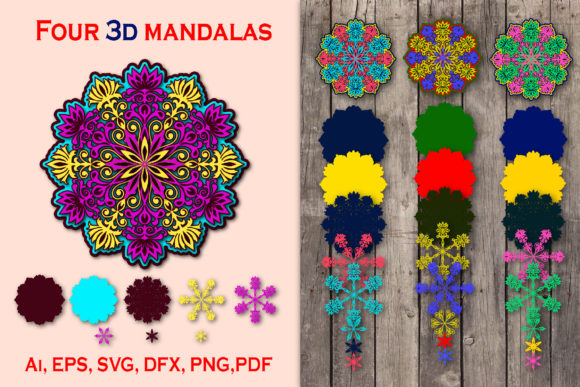
Four Bright 3D Mandalas: A Practical Guide to Integrating Creative Flow in Daily Workflows
The concept of Four Bright 3D Mandalas has gained traction among professionals and creatives seeking structured yet flexible tools to enhance productivity, focus, and creative output. While the term may sound abstract, it represents a practical framework for organizing thoughts, tasks, and goals in a way that aligns with both cognitive processes and real-world execution. Understanding how to apply Four Bright 3D Mandalas can help individuals streamline their workflows, improve decision-making, and maintain consistency across various projects and responsibilities.
Understanding the Structure of Four Bright 3D Mandalas
At its core, Four Bright 3D Mandalas is a visual and conceptual tool designed to break down complex processes into manageable components. The "four bright" aspect refers to four primary elements or stages, while the "3D" suggests depth, dimension, and interactivity. This model can be applied to planning, execution, and reflection in any workflow where clarity and structure are essential.
The framework is not a rigid system but rather a adaptable approach that encourages users to define their own four key areas—such as goals, resources, actions, and outcomes—and then explore how these interact in three dimensions: time, space, and relationships. This allows for a more holistic view of a project or task, making it easier to identify potential bottlenecks, optimize resource allocation, and maintain momentum.
Applying Four Bright 3D Mandalas in Different Stages of a Project
One of the greatest strengths of Four Bright 3D Mandalas is its versatility. It can be used at various points in a project lifecycle, from initial planning to final evaluation. For example, during the planning phase, it helps clarify objectives and identify the necessary steps to achieve them. By mapping out the four elements and their interdependencies, users can create a roadmap that is both comprehensive and actionable.
During execution, the framework serves as a reference point for staying on track. If a task starts to deviate from the original plan, the user can revisit the mandala to reassess priorities, adjust strategies, and reallocate resources. This ensures that the work remains aligned with the broader vision while allowing for flexibility when needed.
After completion, Four Bright 3D Mandalas can be used for reflection and improvement. By analyzing how each of the four elements performed, users can identify what worked well and what could be refined. This iterative process supports continuous learning and growth, making it an invaluable tool for long-term success.
Integrating Four Bright 3D Mandalas with Other Tools and Methods
While Four Bright 3D Mandalas is a powerful standalone tool, it works best when combined with other methods and platforms. For instance, it can complement traditional project management systems like Trello, Asana, or Notion by providing a visual and conceptual foundation for task organization. When integrated with these tools, the mandala becomes a strategic guide that informs daily actions and decisions.
It also pairs well with time management techniques such as the Pomodoro method or time blocking. By using the mandala to define key priorities and deadlines, users can better allocate their energy and attention throughout the day. Additionally, it can be used alongside creative tools like Canva, Adobe Spark, or even simple sketching apps to visualize ideas and concepts in a more dynamic way.
Practical Implementation Tips for Using Four Bright 3D Mandalas
To get the most out of Four Bright 3D Mandalas, start by identifying the four key elements relevant to your current task or project. These could be anything from "goals," "resources," "actions," and "outcomes" to more specific categories depending on the context. Once defined, take time to map out how these elements interact in terms of time, space, and relationships.
Use a digital or physical canvas to draw or sketch the mandala, ensuring that each element is clearly represented and connected. This visual representation can serve as a daily reference, helping you stay focused and aligned with your objectives. Regularly review and update the mandala as circumstances change, keeping it a living document that evolves with your work.
Another effective strategy is to involve others in the process. If working in a team, encourage members to contribute their perspectives on the four elements, fostering collaboration and shared understanding. This not only enhances the accuracy of the mandala but also builds a sense of ownership and accountability among team members.
Workflow Examples and Use Cases
Consider a scenario where a marketing professional is launching a new campaign. Using Four Bright 3D Mandalas, they might define the four elements as "objectives," "audience," "content," and "metrics." They would then explore how these elements interact over time, within different channels, and with various stakeholders. This approach ensures that every aspect of the campaign is considered and optimized for maximum impact.
For a freelance writer managing multiple projects, the four elements could be "topics," "sources," "writing schedule," and "deliverables." Mapping these out in a 3D format helps the writer prioritize tasks, manage deadlines, and maintain quality across all assignments. It also provides a clear structure for evaluating progress and adjusting strategies as needed.
In a personal development context, someone aiming to build a habit might use the mandala to outline "goal," "trigger," "action," and "reward." This visualization makes it easier to track progress, identify obstacles, and reinforce positive behaviors over time.
Factors to Consider for Long-Term Success
When integrating Four Bright 3D Mandalas into a routine, several factors should be taken into account to ensure long-term effectiveness. Preparation is key—taking the time to clearly define the four elements and their relationships sets the stage for successful implementation. Consistency is equally important; regularly revisiting and updating the mandala helps maintain alignment with evolving goals and circumstances.
Usability is another critical factor. The mandala should be easy to access, modify, and share, whether through digital tools or physical notes. Organization plays a role here, as a cluttered or disorganized mandala can lead to confusion and inefficiency. Finally, quality control should not be overlooked—ensuring that the mandala reflects accurate and relevant information helps maintain its value as a guiding tool.